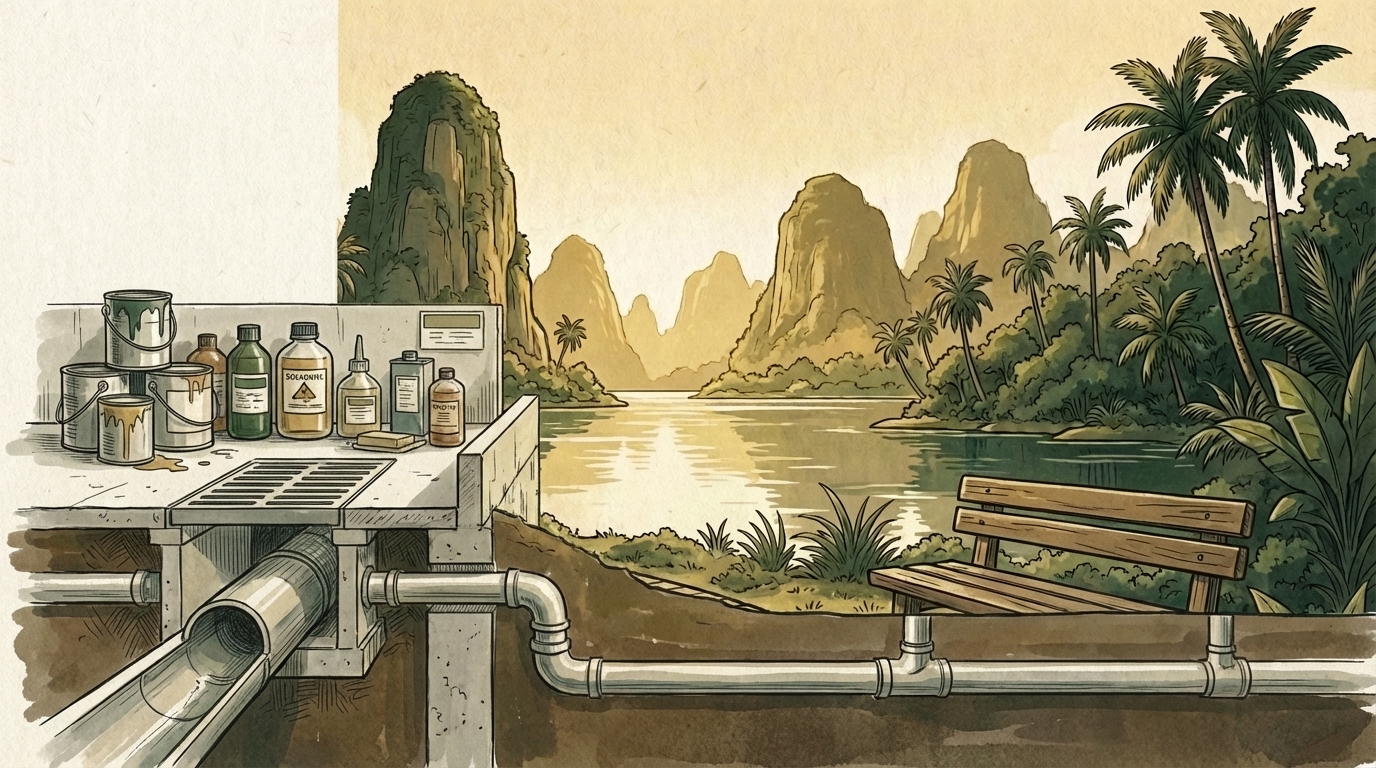
Living next to a natural lake comes with a quiet responsibility: what goes down our drains matters. This guide covers the safe, proper way to dispose of common household chemicals, so our lake, river, and shared environment stay protected for years to come.
Storm drains vs sewage: know the difference
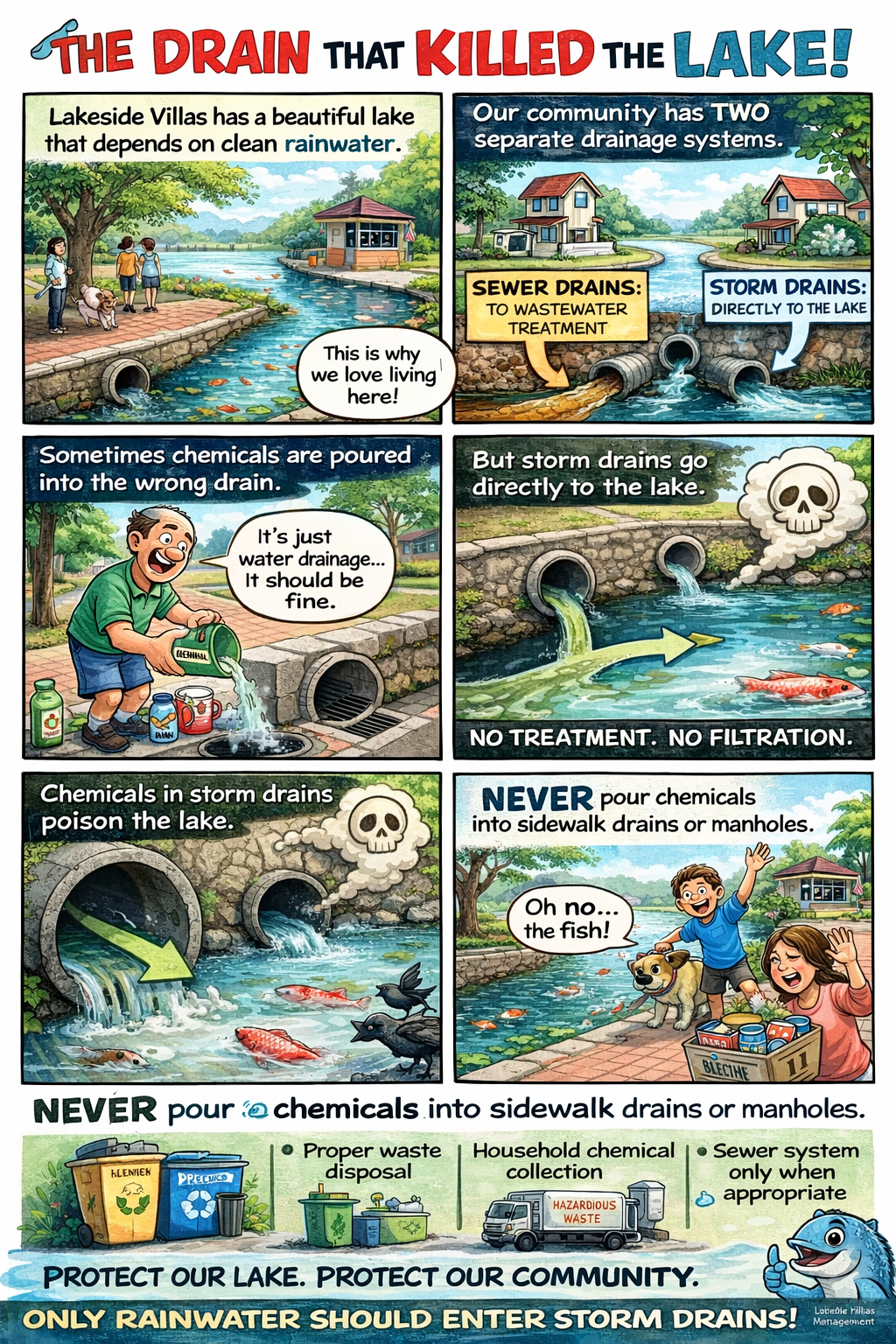
This is the most important thing to understand. Our community has two separate drainage systems, and they work very differently:
Storm drains (roadside drains)
The open drains along our roads and walkways are storm drains. These carry rainwater directly into the lake and river, with no treatment, no filtering, nothing in between.
Anything poured into a storm drain flows straight into our lake.
Sewage drains (household plumbing)
Your sinks, toilets, and indoor drains connect to the sewage system, which carries wastewater to a treatment facility before it’s released.
This means your kitchen sink is a safer outlet than the roadside drain, but it’s still not the right place for chemicals.
What NOT to pour down any drain
These common household items should never go down storm drains, sinks, or toilets:
- Paint (latex or oil-based)
- Paint thinner, turpentine, or solvents
- Motor oil or lubricants
- Pesticides and herbicides
- Cleaning solvents and degreasers
- Pool chemicals
- Batteries and battery acid
- Cooking oil in large quantities
Even “biodegradable” cleaners can harm the lake’s ecosystem when concentrated.
Under Malaysian law, many of these items are officially classified as scheduled wastes, including paints (SW 416/417), solvents (SW 322/323), and used oil (SW 305). This means they must be disposed of through proper channels, not poured down any drain.
The right way to handle each type
Paint and paint-related products
- Latex paint: Let it dry out completely in the can (leave the lid off in a ventilated area). Once solid, it can go in regular household waste.
- Oil-based paint, thinner, turpentine: These are classified as scheduled waste under federal law. Store in the original container with the lid sealed and bring to a collection point (see below).
- Small amounts: Absorb with newspaper or sawdust, let dry, then dispose as regular waste.
Cleaning chemicals and solvents
- Never mix chemicals. Some combinations produce toxic fumes.
- Keep in original containers with labels intact.
- Bring to a scheduled waste collection point.
Motor oil and lubricants
- Collect used oil in a sealed container.
- Most workshops and petrol stations in Ipoh accept used motor oil. Petronas and Shell stations typically have collection points.
Cooking oil
- Small amounts can be wiped with paper towels and binned.
- Larger amounts should be collected in a bottle and taken to a used cooking oil collection point; some recycling centres and restaurants accept it.
Batteries
- Regular batteries: Place in designated battery recycling bins (available at most shopping malls including AEON Kinta City).
- Car batteries: Return to the shop where you purchase the replacement; they are required to accept the old one.
Storing chemicals at home
If you can’t dispose of chemicals immediately, Malaysian regulations allow on-site storage for up to 180 days provided you:
- Keep them in the original containers, sealed and upright
- Store in a cool, dry, ventilated area away from drains and heat sources
- Never mix incompatible chemicals. Some reactions can produce toxic gas or fire
- Keep containers labelled with the contents and date
Where to take hazardous waste in Ipoh
| Facility | What they accept | Contact |
|---|---|---|
| Licensed scheduled waste contractors | Chemicals, solvents, paint, hazardous waste | Arrange via DOE Perak (see below) |
| Petronas / Shell stations | Used motor oil | Various locations in Ipoh |
| AEON Kinta City | Battery recycling bins | Kinta City mall |
| Local recycling centres | Cooking oil, electronics | Check with MBI for nearest centre |
Key contacts
Department of Environment (DOE) Perak 9th Floor, Bangunan Seri Kinta, Jalan Sultan Idris Shah, 30000 Ipoh Tel: 05-254 2744
Contact DOE Perak for guidance on licensed scheduled waste collectors, to report environmental pollution, or to arrange disposal of large quantities of hazardous waste (e.g. from renovations).
Majlis Bandaraya Ipoh (MBI) Tel: 05-208 3333 For general waste management, storm drain maintenance, and municipal services.
A few easy habits that make a big difference
- Store chemicals properly. Keep lids sealed and containers upright in a cool, dry area away from drains.
- Check before you pour. If you’re unsure whether something can go down the sink, it probably shouldn’t. Ask Seroja on Telegram for quick guidance.
- Wash paint brushes wisely. Rinse latex paint brushes in a bucket, not under a running tap. Let the solids settle, then dispose the residue as solid waste.
- During renovations, remind your contractors that our drains flow into the lake. Ask them to contain and remove all chemical waste.
- Report spills immediately. If you see a chemical spill near a storm drain, contact the committee via Telegram or email, and report to DOE Perak at 05-254 2744. Under federal law, spills must be reported and cleaned up promptly.
What the law says
You don’t need to be a lawyer to get this right, but it’s worth knowing: Malaysia’s Environmental Quality Act 1974 (amended in 2024 by Act A1712) has clear rules about this, and the penalties were recently made significantly stricter.
- Section 25 prohibits discharging pollutants or hazardous substances into inland waters (which includes our lake and river). The penalty is now mandatory imprisonment of up to 5 years, plus a fine of not less than RM50,000 and up to RM10 million.
- Section 34B requires scheduled wastes (paints, solvents, oils) to be disposed of only at prescribed premises by licensed contractors. The penalty is mandatory imprisonment of up to 5 years, plus a fine of not less than RM100,000 and up to RM10 million.
The 2024 amendment made imprisonment mandatory, not optional, reflecting how seriously the government now treats environmental pollution. These aren’t obscure regulations; they’re actively enforced by the Department of Environment.
The good news is that following the steps in this guide keeps you well within the law. You can read the full legislation on the DOE website.
Why this matters here
Our 10-acre lake is not connected to a water treatment system. It’s a living ecosystem, home to fish, birds, and the greenery that makes Lakeside Villas special. A single can of paint thinner poured into a storm drain can contaminate a significant volume of water and harm aquatic life.
By handling our waste properly, we’re not just following rules. We’re taking care of the landscape that drew us all here in the first place.
Proper waste disposal is one part of sustainable living; reducing your energy footprint is another. Many homeowners in Ipoh are switching to solar to cut electricity bills and reduce their environmental impact. If you’re curious, this cost-benefit analysis for Ipoh homes breaks down the real numbers.
Have a question about waste disposal or need help finding a collection point? Chat with Seroja on Telegram, available 24/7.