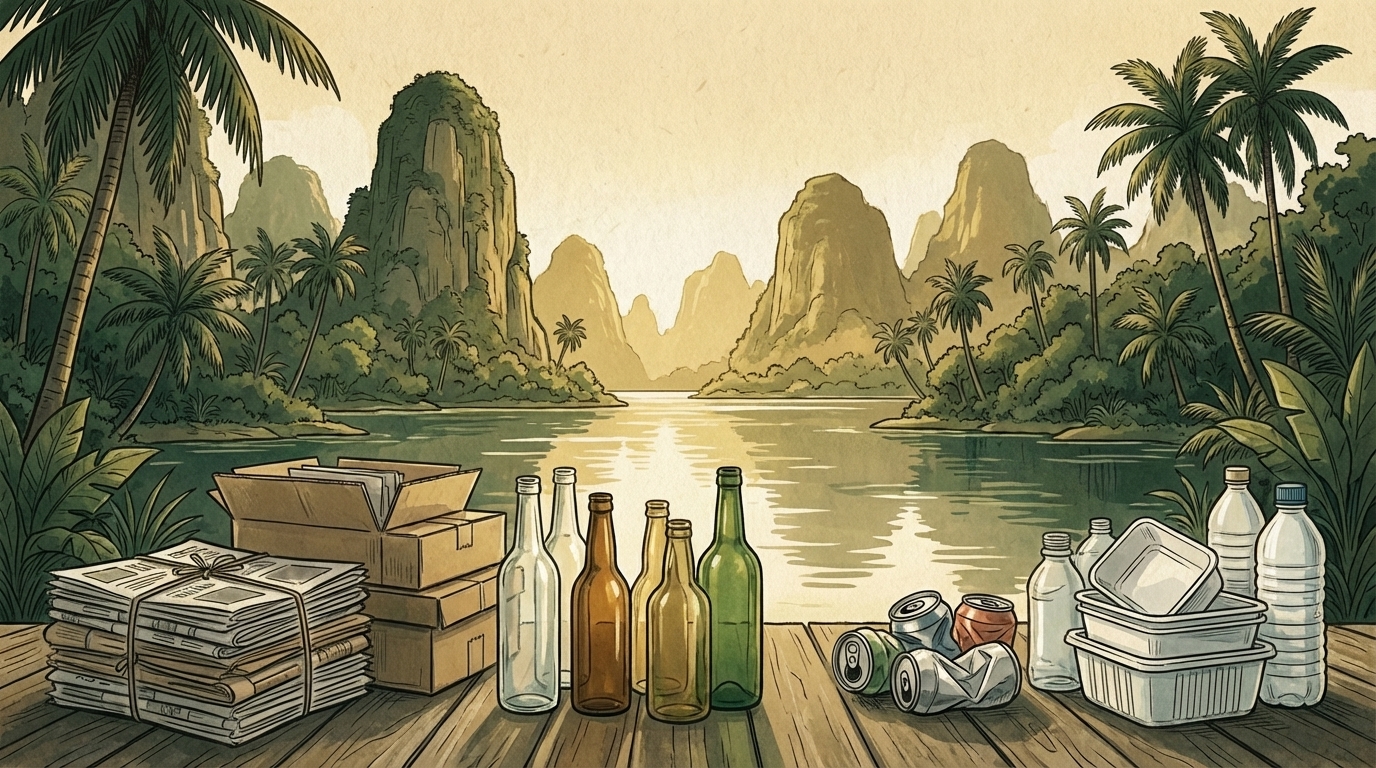
Most of us at Lakeside Villas put everything into one bin. General waste goes out on Monday, Wednesday, and Friday, and that’s that. Everything ends up in the same landfill: food scraps, plastic bottles, cardboard boxes, glass jars, tin cans, all mixed together.
This guide is a starting point. There’s no recycling collection in our area yet, but there are things we can do right now, and the first step is understanding what recycling actually means and why it’s worth the small effort.
Recycling is simply the process of sorting out materials that can be turned into new products, instead of burying them in a landfill. Paper becomes new paper. Aluminium cans become new cans. Plastic bottles become new containers. But it only works if those materials are separated from the rest of our waste and kept clean enough to process.
Why bother recycling?
It’s a fair question, especially when there’s no separate collection for it yet. Here’s why it’s still worth doing:
It reduces landfill waste
Malaysia sends over 38,000 tonnes of waste to landfills every day. A significant portion of that is material that could have been recycled: paper, plastic, metal, glass. Landfills are filling up, and new ones are increasingly hard to site. The less we send, the longer they last.
It saves natural resources
Every aluminium can you recycle means less bauxite needs to be mined. Every cardboard box means fewer trees cut down. Recycling a single tonne of paper saves roughly 17 trees and 26,000 litres of water.
It keeps our environment cleaner
Waste that isn’t managed properly ends up in rivers, drains, and eventually the ocean. We live next to a natural lake and river, and we’ve already seen how waste in our storm drains flows directly into these waterways.
It can put money in your pocket
Several recycling services in Ipoh actually pay you for your recyclables. It’s not a fortune, but it adds up, and it means your “rubbish” has value.
The basics: what can be recycled?
Not everything in your bin is rubbish. Here’s what can typically be recycled, broken into four main categories:
Paper and cardboard
- Newspapers, magazines, catalogues
- Cardboard boxes (delivery boxes, cereal boxes, etc.)
- Office paper, envelopes, notebooks
- Beverage cartons (Milo, juice boxes; these are made by Tetra Pak and have their own recycling stream)
Cannot be recycled: Tissues, paper towels, napkins, paper plates with food on them, wax-coated paper.
Plastic
- Water and drink bottles (look for the recycling triangle on the bottom)
- Food containers (ice cream tubs, takeaway containers)
- Shampoo and detergent bottles
- Plastic bags (some centres accept these, but many don’t, so check first)
Cannot be recycled: Styrofoam (polystyrene), plastic wrap/cling film, plastic sachets (like 3-in-1 coffee packets), or any plastic still covered in food (e.g. a greasy takeaway container).
Metal (tin cans and aluminium)
- Drink cans (Coke, beer, etc.; these are aluminium and are the most valuable recyclable)
- Tin cans (canned food: sardines, beans, corn, etc.)
- Aerosol cans (empty ones)
Cannot be recycled at most centres: Aluminium foil that’s been heavily soiled, paint cans with residue.
Glass
- Glass bottles (soy sauce, jam, wine, beer)
- Glass jars (pasta sauce, pickles, etc.)
Cannot be recycled: Broken glass (safety issue; wrap and dispose as general waste), light bulbs, mirrors, ceramics, pyrex/heat-resistant glass.
The golden rule: clean it before you bin it
This is the part most people miss, and it’s the reason a lot of recyclable material ends up in landfill anyway.
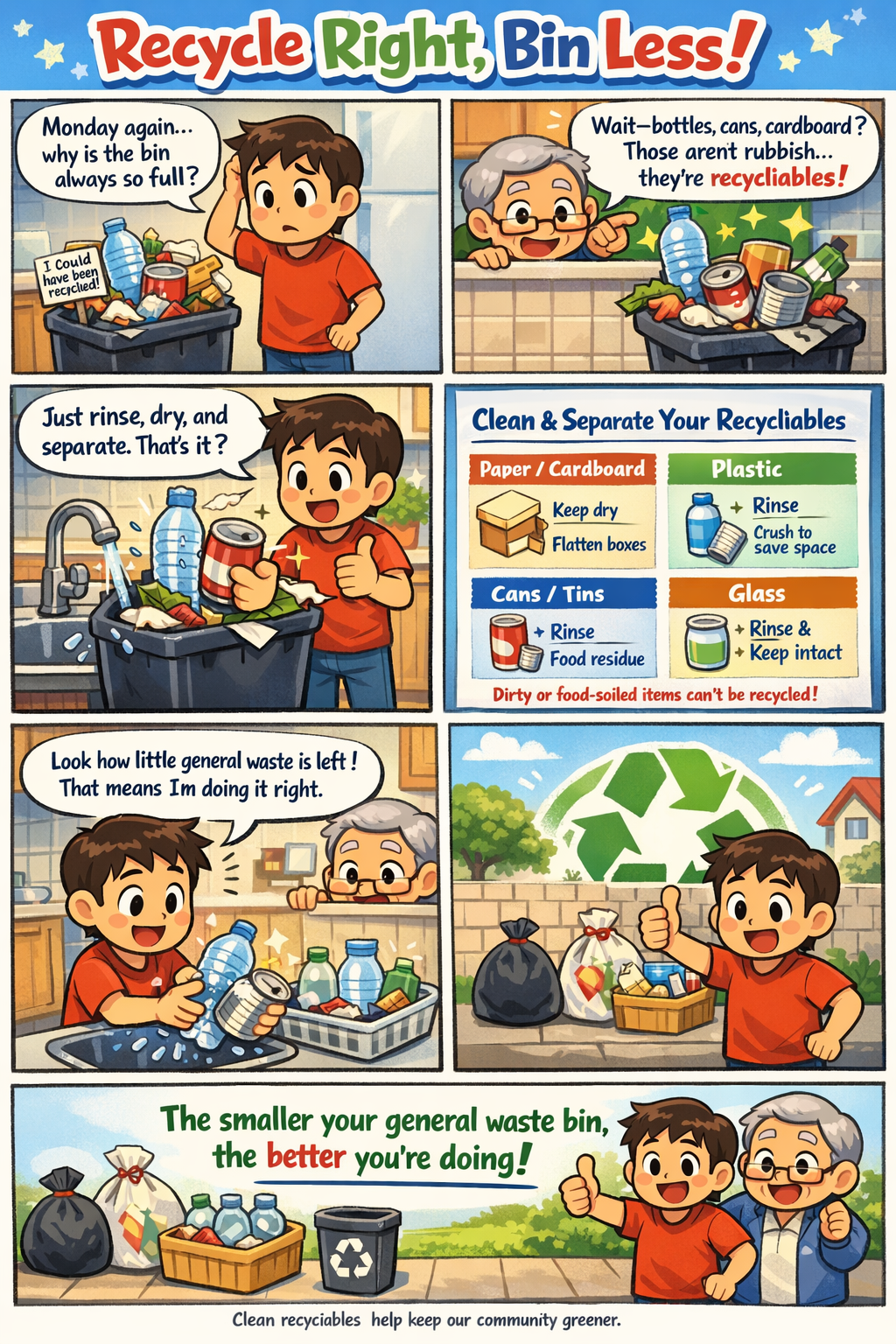
Recyclables must be clean and dry.
A plastic bottle with leftover Milo in it? That contaminates the entire batch. A cardboard box soaked with curry? That’s no longer recyclable. A tin can with sardine oil still inside? Same problem.
What “clean” actually means
You don’t need to scrub everything spotless. Just:
- Empty it. Pour out any remaining liquid or food.
- Give it a quick rinse. A few seconds under the tap is enough. You’re removing food residue, not sterilising it.
- Let it dry. Wet recyclables (especially paper and cardboard) get mouldy and become unusable.
That’s it. Rinse and dry. It takes 10 seconds per item and makes the difference between something being recycled and something going to landfill.
A practical tip
Keep a small tub or basin near your sink. After you finish a bottle, can, or container, rinse it and put it in the tub to dry. Once dry, move it to your recycling collection area.
How to separate at home
You don’t need a complicated system. Start simple:
The two-bin method
At minimum, keep two separate areas for your waste:
- General waste: food scraps, tissues, soiled items, anything that can’t be recycled. This goes out on collection days as usual.
- Recyclables: clean, dry items sorted loosely by type.
A second bin, a bag, a box, or even a corner of your utility area works fine. The goal is to stop recyclable items from going into the general waste bin.
Here’s a good way to think about it: the less that goes into your general waste bin, the better you’re doing. If you’re recycling effectively, your general waste bag on collection day should feel noticeably lighter, mostly just food scraps and soiled items. When your general waste bin is almost empty, that’s a sign you’ve got your waste management right.
If you want to go further
Separate your recyclables into categories:
- Paper/cardboard: flatten boxes to save space. Keep paper dry.
- Plastic: crush bottles to save space. Remove caps (they’re often a different type of plastic).
- Metal: rinse cans, remove labels if you can (not essential).
- Glass: handle carefully. Keep jars and bottles intact.
Store them in separate bags or boxes. When you have enough, take them to a drop-off point or request a collection.
How much space does it take?
Less than you’d think. A reusable shopping bag for each category, stored in your kitchen or utility area, is all you need. Flatten your cardboard and crush your bottles; a week’s worth of recyclables for a typical household fits into a space smaller than a laundry basket.
What about food waste?
Food scraps (rice, bones, vegetable peels, fruit skins) are not recyclable, but they don’t have to go to landfill either. Composting is an option if you have garden space, and it produces excellent fertiliser for your plants.
That’s a topic for another article. For now, the focus is on the easy wins: paper, plastic, metal, and glass.
Where to take your recyclables in Ipoh
Since we don’t have kerbside recycling collection yet, here are your best options:
Door-to-door collection: Trash4Cash
This is the most convenient option available to us right now. Trash4Cash operates in Perak and will come to your home to collect recyclables.
- How it works: Download the Trash4Cash app, request a pickup, and their team arrives with a weighing scale. They weigh your recyclables and pay you via the app within 48 hours.
- What they accept: Paper, cardboard, plastic, aluminium cans, e-waste, used cooking oil
- Cost: Free; they pay you (average ~RM18 per 50kg)
- Contact: 019-472 9020
- App: Available on Google Play Store
Nearest drop-off centres
There are over 15 MBI-licensed recycling companies in the Ipoh area. Here are the closest to Sunway City:
| Centre | Distance | Accepts | Rating |
|---|---|---|---|
| Kavari Enterprise | ~2 km | General | 4.3 |
| Seng Kong Recycle | ~3 km | Paper, fibre | 3.8 |
| MSSB Metal Scrap | ~3 km | Metal | 4.3 |
| Green Resource Recovery | ~4 km | General, e-waste | 5.0 |
| Kitaran Berjaya | ~4 km | General | 5.0 |
For the full list with addresses, phone numbers, opening hours, and Google Maps directions, see our complete directory of licensed recycling centers in Ipoh.
Beverage cartons: Tetra Pak drop-off points
If you drink boxed drinks (Milo, juice, soy milk), the cartons can be recycled separately through Tetra Pak Malaysia’s Recycle Easy programme. Drop-off points are listed at recycle-easy.com.my.
Can we get recycling collection at Lakeside Villas?
We’re looking into it. MBI (Majlis Bandaraya Ipoh) has been expanding their circular economy programme to residential communities across Ipoh, and we’d like to bring something similar to Lakeside Villas.
Options being explored include:
- A community recycling collection point: a designated area within Lakeside Villas where residents can drop off sorted recyclables for regular collection.
- Partnering with Trash4Cash for scheduled community pickups rather than individual requests.
- Joining MBI’s circular economy programme: MBI has partnered with companies that handle specific waste streams (e-waste, cooking oil, beverage cartons, textiles, tyres) and is rolling this out to residential areas.
If you’re interested in helping make this happen or have ideas, reach out to the committee via Telegram.
Start small, start now
You don’t have to be perfect. Even separating just your drink cans and plastic bottles from the general waste is a meaningful start. Once the habit forms, adding cardboard and glass is easy.
Here’s a simple challenge: this week, rinse and set aside every drink can and plastic bottle instead of throwing them in the bin. See how quickly they accumulate. Then take them to one of the drop-off points above, or call Trash4Cash for a pickup.
Small actions, done consistently by many households, add up to a real difference for our community, for Ipoh, and for the environment we all share.
Have a question about recycling or waste disposal? Chat with Seroja on Telegram, available 24/7.