Every so often, a tree in one of our common areas becomes inconvenient. Leaves in the gutter. Branches over the car. A crown so wide it shades half the road. Someone knows someone who’ll come with a chainsaw for a few hundred ringgit, and just like that, the problem is gone.
Except it isn’t — not legally, not environmentally, and not fairly to your neighbours. This article explains what the law says, what the community expects, and why felling a mature tree should always be a last resort.
It’s probably not your tree to cut
Lakeside Villas is a landed housing development, not a strata development. That matters because the Strata Management Act 2013 does not apply here, and we don’t have a Joint Management Body or Management Corporation in the strata sense.
Instead, we’re organised as a Residents’ Association — P.P. Lakeside Villas (2025) S.C.I.P. — registered under the Societies Act 1966. The RA represents the community but does not hold legal title to the common areas: the verges, the jogging track, the riverside strips, the landscaped areas.
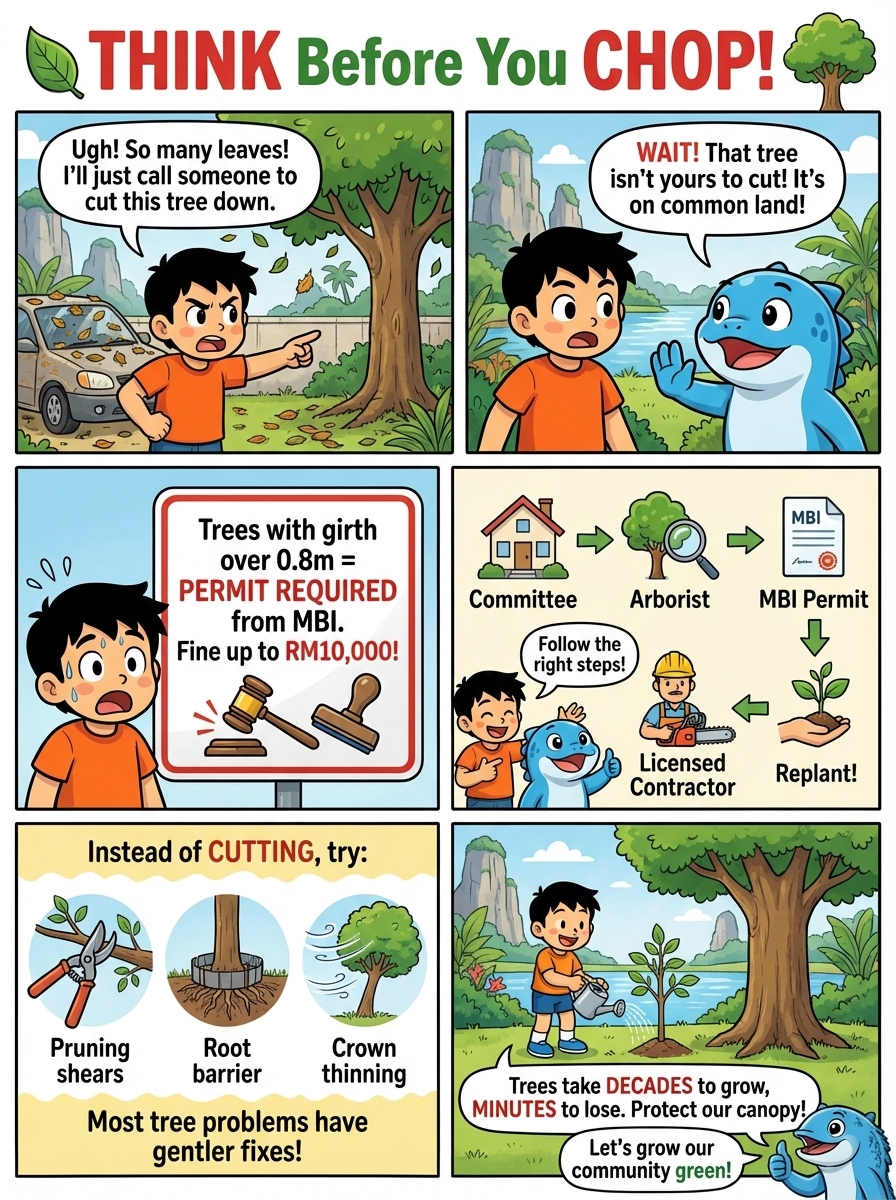
Those common areas typically belong to the developer (Sunway City (Ipoh) Sdn Bhd) or, where roads and drains have been formally handed over, to Majlis Bandaraya Ipoh (MBI). In either case, the trees standing on them are not yours, not your neighbour’s, and not the RA’s to cut.
Cutting a tree on land you don’t own — even if it overhangs your property — can constitute trespass or criminal damage to someone else’s property. Insurance won’t help if something goes wrong, and the person who swung the chainsaw is rarely the only one liable.
It’s also regulated by law
Malaysia has had a Tree Preservation Order framework since 1995, under the Town and Country Planning Act 1976 (Act 172), Part VA, Sections 35A–35H. Perak is one of only three peninsular states to have formally gazetted its rules — the Perak Tree Preservation Order Rules 2011. Selangor was first in 2001; Melaka followed in 2017. The law is live here, not theoretical.
The 0.8 metre rule
Section 35H of Act 172 states, in effect:
No person shall, without the written permission of the local planning authority, fell a tree with a girth exceeding 0.8 metres, unless the tree is dying, dead, or poses an imminent danger.
A few specifics that trip people up:
- Girth is measured at 0.5 metres from the ground (for trees with buttress roots, above the buttress). This is written into s.35H(2). It is not the international “breast height” standard of 1.3 m — so more trees qualify than you might think.
- 0.8 m girth works out to roughly 25 cm diameter, about the thickness of an adult’s forearm. Most mature shade trees at Lakeside Villas clear this threshold comfortably.
- The local planning authority for us is Majlis Bandaraya Ipoh (MBI).
The penalty
Cutting a protected tree without written permission carries a fine of up to RM10,000 or imprisonment up to 3 months, or both (Act 172, s.35H(3)). If the tree stands on gazetted forest reserve or state land, the National Forestry Act can apply higher penalties again.
The narrow exceptions
You do not need permission if the tree is:
- Dead
- Dying
- Creating an imminent danger (e.g. visibly leaning, split trunk, likely to fall in the next storm)
“Imminent” is doing a lot of work in that sentence. A tree being inconvenient, large, or messy is not imminent danger. When in doubt, get a qualified assessment — not a chainsaw.
The right procedure
If a tree genuinely needs to come down, this is how it should be done:
- Raise it with the committee. Telegram, email, or a meeting — whichever works. Do not call a contractor directly.
- The committee inspects. Often the issue can be solved by pruning, not felling.
- Arborist assessment if it’s borderline. ISA-certified arborists in Malaysia can perform a formal Tree Risk Assessment and, crucially, recommend alternatives.
- MBI application if felling is justified. Typical documentation councils ask for:
- Location plan
- Tree inventory (species, girth at 0.5 m, height, condition, photos)
- Reason for removal
- Replanting proposal
- MBI site inspection by a landscape or planning officer.
- Written approval, usually with conditions attached — replacement species, number of saplings, debris disposal, stump treatment.
- Licensed contractor performs the work.
Does a new tree have to be planted?
The Act itself does not universally require replanting, but local councils almost always attach a replanting condition to any felling permit. Typically 1-for-1 or 2-for-1, often with native species specified. It’s standard practice, and for good reason — you’re compensating the community for the canopy you removed. (Section 35E of Act 172 does impose a statutory duty to replace trees felled in contravention of a Tree Preservation Order — so in the worst case, replacement is the law, not a courtesy.)
Do the roots have to come out?
Not legally. But a few things to consider:
- Leaving a stump invites termites, fungi, and eventual regrowth.
- Full root extraction is risky in our karst terrain — limestone, shallow alkaline soils, sinkhole sensitivity. Aggressive digging can destabilise adjacent trees, slopes, and even nearby structures. (See our article on living among limestone for why the ground beneath us deserves respect.)
- Stump grinding — reducing the stump to below grade without disturbing the deep roots — is the standard compromise and is often imposed as a permit condition.
Why felling should be a last resort
Mature trees do a staggering amount of unglamorous work for our community. Here’s what we lose when one comes down:
Cooling
In a tropical climate, trees are the cheapest air conditioner we have. A study in George Town, Penang modelled street-tree canopy providing up to 7°C of cooling at street level over a 50-year horizon. Shaded surfaces are measurably cooler than unshaded ones — the difference ranges into 10–25°C depending on canopy density and the material below. Well-placed shade trees have been shown to cut building cooling energy by 25–30% in various studies.
For a community of south-facing homes in Perak’s climate, that is not abstract. That is your electricity bill.
Stormwater and water quality
Tree canopies intercept rainfall before it hits the ground. Their roots stabilise soil and slow runoff. Without them, more silt and more nutrients wash into our storm drains — which, as the dog-walking article already noted, drain directly into our river and lake.
Biodiversity
Mature canopy trees are habitat. Monitor lizards, kingfishers, otters, and bats all use the tree line along the jogging track and the river. The Kinta Valley’s karst already hosts species found nowhere else on earth — removing mature trees removes the habitat corridor that connects them to the wider landscape.
Carbon
A single mature tropical tree sequesters roughly 20–25 kg of CO₂ per year as a conservative estimate; large canopy trees sequester substantially more. In December 2024, Malaysia’s National 100 Million Tree Planting Campaign hit its target ahead of schedule, with the Prime Minister planting the 100 millionth tree at the Parliament complex. Cutting mature trees for nuisance, while the country is investing in saplings, is — to put it mildly — incoherent.
Most “tree problems” have gentler fixes
Before anyone reaches for a chainsaw, here’s what an arborist would suggest:
| The complaint | What usually works instead |
|---|---|
| Too many leaves falling | Seasonal composting, mulching, or crown thinning |
| Branches over roof or car | Selective pruning |
| Roots cracking driveway | Root pruning + root barrier installation |
| Blocking a view | Crown raising, not removal |
| Attracting birds, bats, or monkeys | Species-specific — removing one tree rarely solves it |
| “It’s just too big” | Crown reduction by a certified arborist |
Felling is appropriate when the tree is genuinely dead, diseased beyond recovery, or unstable. For almost everything else, there is a more proportionate answer.
If you have a concern about a tree
The path is simple, and the same for every issue:
- Message the committee first on Telegram. Describe the tree, send photos, and say what the problem is.
- If the committee agrees there’s an issue, the right process follows: inspection, arborist if needed, MBI application, licensed contractor, replanting.
- If you’re unsure whether something counts as “imminent danger,” that’s exactly when an arborist should be the next call — not a tree cutter.
Mature trees take decades to grow and minutes to lose. The cost of a missed permit is an RM10,000 fine. The cost of a lost tree is something none of us can put back. A little patience and a little process keeps our community greener, cooler, and within the law.
Have a question about tree care, common areas, or community rules? Chat with Seroja on Telegram, available 24/7.